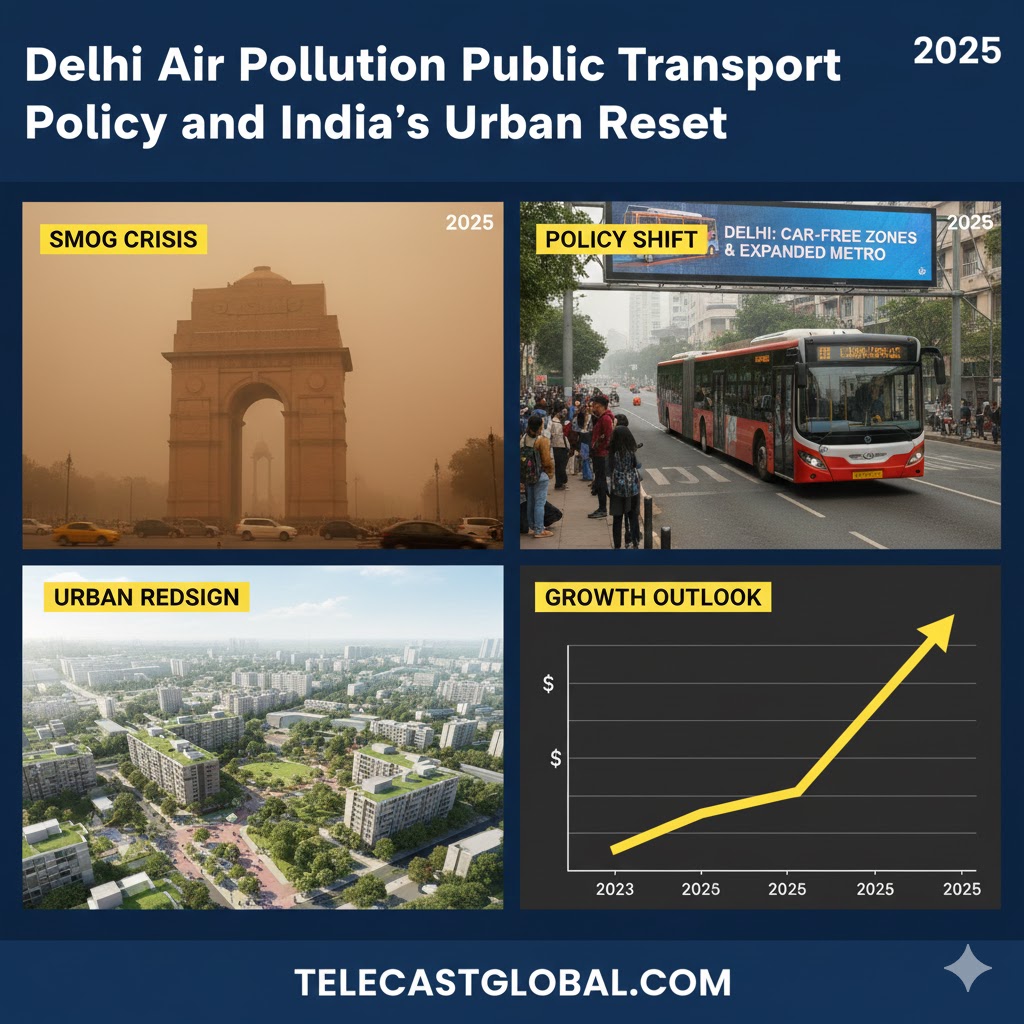
Delhi Air Pollution Public Transport Policy and India’s Urban Reset
Table of Contents
Delhi air pollution public transport policy has moved from seasonal firefighting to year-round governance, reflecting a deeper shift in India’s urban strategy. The attached document captures a crucial moment: the Centre pushing structural transport reform instead of cosmetic emergency measures. As 2026 unfolds, this approach aligns with global trends—clean mobility mandates, climate accountability, and public health economics shaping city policy worldwide. With NCR pollution now recognised as a regional, not local, failure, public transport is no longer just infrastructure—it is climate policy, industrial policy, and social policy rolled into one. The file’s narrative fits squarely into this global reset.
Why Delhi Air Pollution Public Transport Policy Became a Governance Priority in 2026
Delhi air pollution public transport policy became a governance priority in 2026 not because the problem was new, but because denial finally became politically and economically untenable. The data trajectory outlined in the file shows a city that never recorded a single “good air” day in 2025, with PM2.5 levels routinely crossing five times India’s own safety limits and nearly twenty times WHO guidelines . By early 2026, pollution was no longer viewed as a winter inconvenience—it was a year-round governance failure with direct implications for health expenditure, workforce productivity, and investor confidence.
At the core of this shift is accountability. Monthly ministerial reviews ordered by the Union Environment Ministry signal a break from episodic crisis management toward continuous oversight. Delhi air pollution public transport policy moved to the center because transport emissions are one of the few levers the state can control consistently. Unlike stubble burning or regional wind patterns, urban mobility decisions sit squarely within administrative reach. When governance systems face persistent failure, they focus first on what they can actually fix—and transport tops that list.
Another reason Delhi air pollution public transport policy gained urgency in 2026 is the economic cost of inaction. Respiratory and cardiovascular illnesses linked to PM2.5 have translated into rising public health burdens and lost workdays. In a slowing global economy, India cannot afford megacities that silently bleed productivity. Clean air has shifted from being an environmental ideal to a hard economic input. Public transport, especially high-capacity systems like buses and metro rail, offers the highest emissions reduction per rupee spent—something policymakers increasingly understand.
The governance lens also widened beyond Delhi’s borders. The document highlights that nearly 65 percent of Delhi’s pollution originates outside the city. This reality exposed the limits of city-only solutions and forced a regional coordination mindset. Delhi air pollution public transport policy thus became a model intervention: if fewer private vehicles enter the city daily from NCR towns, emissions fall regardless of where pollution originates. Transport reform became a proxy for regional air-shed management without waiting for complex inter-state environmental treaties.
Global pressure mattered too. By 2026, climate financing, urban infrastructure loans, and ESG-linked investments increasingly factor air quality indicators into risk assessments. Delhi’s global image as one of the world’s most polluted capitals was no longer a reputational issue alone—it affected capital flows and tourism. Aligning Delhi air pollution public transport policy with electric buses, metro expansion, and digital ticketing allowed India to signal seriousness on climate governance without imposing harsh lifestyle restrictions on citizens.
Finally, political realism played its role. Measures like odd-even vehicle rules proved temporary and unpopular, while enforcement-heavy bans invited resistance. Public transport reform, by contrast, is politically saleable. It offers visible benefits—cheaper travel, better connectivity, jobs in electric mobility—while quietly delivering emission cuts. In governance terms, it is low-conflict, high-impact policy.
In short, Delhi air pollution public transport policy rose to priority status in 2026 because it sat at the intersection of health, economics, climate credibility, and administrative control. When everything else became complicated, moving people efficiently and cleanly became the most practical place to start.
From Private Vehicles to Mass Transit: The Economic Logic Behind Cleaner Air
The economic logic behind cleaner air in Delhi becomes unmistakable when viewed through the lens of mobility. Delhi air pollution public transport policy gained traction in 2026 because private vehicle dominance is not just an environmental failure—it is an economic inefficiency on a massive scale. The attached file makes it clear that road transport is a major contributor to PM2.5 and nitrogen oxides, with congestion, idling, and stop-start traffic multiplying emissions per kilometre . In simple terms, Delhi has been burning more fuel to move fewer people, and paying the price in both money and health.
From a cost-benefit perspective, mass transit delivers superior returns. One standard city bus can replace 30–40 private cars, while a fully loaded metro train replaces hundreds. This substitution effect is central to Delhi air pollution public transport policy. Fewer vehicles mean lower aggregate fuel consumption, reduced road wear, less congestion-related productivity loss, and a sharp drop in localized pollution hotspots. Economists often describe this as “negative externality correction”—public transport directly reduces the hidden costs that private vehicles impose on society.
Healthcare economics further strengthens the case. The file highlights persistently high PM2.5 and PM10 levels, which are closely linked to respiratory and cardiovascular diseases. These illnesses inflate public healthcare spending and reduce labour efficiency through absenteeism and long-term disability. When policymakers in 2026 evaluated Delhi air pollution public transport policy, they were no longer just comparing buses versus cars—they were comparing preventive investment versus recurring medical expenditure. Clean mobility emerged as the cheaper option over time.
Fuel economics also played a decisive role. India remains heavily dependent on imported oil, exposing the economy to global price volatility. A city dominated by private vehicles magnifies this vulnerability. In contrast, mass transit—especially electric buses and metro rail—decouples urban mobility from crude oil shocks. Delhi air pollution public transport policy aligns neatly with national energy security goals by reducing per-capita fuel demand while electrification shifts consumption toward domestically managed power systems.
There is also a productivity argument that urban planners increasingly emphasize. Congestion imposes what economists call “time tax” on cities. Hours lost in traffic translate into reduced economic output and lower quality of life. By prioritizing buses, metro networks, and multimodal integration, Delhi air pollution public transport policy addresses congestion at scale. Faster, predictable commutes increase workforce participation, especially among women and lower-income groups who rely most on public transport.
Crucially, mass transit benefits from economies of scale in regulation and technology. As the document notes, it is far easier to enforce emission standards, maintenance protocols, and fuel transitions across a centralized fleet than across millions of private vehicles. This makes Delhi air pollution public transport policy administratively efficient. Cleaner technology adoption happens faster when decisions are institutional rather than individual.
Finally, the transition carries employment and industrial spillovers. Electric bus deployment, charging infrastructure, and digital mobility systems create jobs and stimulate domestic manufacturing. Cleaner air, in this sense, is not a cost—it is a by-product of smarter economic organization.
In essence, the move from private vehicles to mass transit is not ideological environmentalism. It is hard-nosed economics. Delhi air pollution public transport policy reflects a mature realization: the cheapest city to run is the one where fewer people need to drive.
Electric Buses, Metro Expansion, and India’s Climate Commitments Converge
Electric buses and metro expansion became central to Delhi air pollution public transport policy in 2026 because they sit at the precise intersection of climate obligations, urban necessity, and economic realism. What once appeared as isolated transport upgrades are now understood as climate instruments. The attached file underscores how transport emissions—especially from private vehicles and diesel fleets—remain a major contributor to PM2.5 and PM10 levels in Delhi NCR . Against this backdrop, electrified mass transit emerged as the fastest scalable solution aligned with India’s national and international climate promises.
At the national level, India’s updated climate commitments increasingly emphasize emissions intensity reduction rather than absolute caps. Delhi air pollution public transport policy fits neatly into this framework. Electric buses deliver immediate local air quality benefits by eliminating tailpipe emissions, while also reducing lifecycle emissions as India’s power grid gradually decarbonizes. Unlike private electric cars, which primarily benefit higher-income households, electric buses multiply impact by serving thousands of commuters daily. This makes them politically defensible and climate-efficient.
The PM-eBus Sewa Scheme highlighted in the file reflects this convergence. By pushing large-scale electric bus deployment through public–private partnerships and payment security mechanisms, the government addressed the two traditional barriers to clean transit: capital risk and operational viability . In 2026, electric buses are no longer pilot projects—they are institutional assets. For Delhi air pollution public transport policy, this marks a shift from experimentation to systemic transformation.
Metro expansion reinforces this logic. Metro rail systems are electrically powered, high-capacity, and land-efficient—three qualities that climate-aligned urban transport demands. As India approaches one of the world’s largest metro networks, metro expansion is no longer just about connectivity; it is about locking cities into low-emission travel patterns for decades. Delhi air pollution public transport policy treats metro corridors as permanent emissions reducers, not short-term pollution fixes.
There is also a strategic sequencing at play. Electric buses address surface-level pollution hotspots quickly, while metro expansion delivers long-term structural change. Together, they form a layered response to air pollution—one tactical, one strategic. This dual-track approach explains why governance attention in 2026 shifted decisively toward transport electrification rather than episodic restrictions like vehicle bans or construction halts.
International climate finance and reputation further accelerated this convergence. Multilateral lenders and green funds increasingly favor projects with measurable emissions outcomes. Electric buses and metro systems offer clear metrics—vehicle kilometers electrified, emissions avoided, ridership shifted. Delhi air pollution public transport policy thus doubles as a signaling mechanism, demonstrating India’s ability to convert climate rhetoric into urban infrastructure.
Importantly, electrified mass transit also reshapes citizen behavior without coercion. When clean, reliable, and affordable options exist, commuters shift voluntarily. This behavioral transition is essential for climate compliance in democratic systems. Unlike fuel taxes or bans, electric buses and metros invite participation rather than resistance.
In sum, electric buses, metro expansion, and India’s climate commitments converged in 2026 because they solved multiple problems at once. Delhi air pollution public transport policy reflects a mature governance insight: climate goals succeed fastest when they are embedded in everyday urban services. Cleaner air, in this model, is not a sacrifice—it is the natural outcome of modern mobility.
Regional Pollution, NCR Coordination, and the Limits of City-Level Solutions
Delhi air pollution public transport policy could not have reached governance priority in 2026 without confronting an uncomfortable truth: Delhi alone is not the problem. The attached file makes this explicit by noting that nearly 65 percent of Delhi’s PM2.5 pollution originates outside city boundaries, primarily from surrounding NCR districts . This data forced policymakers to abandon the long-standing illusion that municipal fixes—sprinkling roads, banning firecrackers, or regulating construction—could solve a regional atmospheric crisis.
Air pollution does not respect administrative borders. Wind patterns, seasonal temperature inversions, and industrial clustering across NCR ensure that emissions from nearby towns flow freely into Delhi’s air-shed. By 2026, governance thinking shifted from city-level blame games to regional coordination. Delhi air pollution public transport policy emerged as a practical workaround to institutional fragmentation. While states may argue over agricultural burning or industrial regulation, transport reform offered a rare lever that cuts emissions across jurisdictions simultaneously.
NCR coordination, however, has always faced structural limits. Different states, political leaderships, and enforcement capacities make uniform environmental regulation difficult. Expecting synchronized industrial controls or construction bans across Haryana, Uttar Pradesh, and Rajasthan has repeatedly proven unrealistic. In this context, Delhi air pollution public transport policy functions as a system-level intervention rather than a regulatory one. Fewer private vehicles entering Delhi daily from NCR towns automatically reduces emissions—regardless of where pollution originates.
The document highlights how road transport remains a dominant pollution source, not only within Delhi but across the region. NCR’s dependence on private vehicles for inter-city commuting amplifies emissions far beyond city limits. By strengthening metro connectivity, expanding bus fleets, and integrating last-mile options, Delhi air pollution public transport policy indirectly reshapes NCR travel behavior. A commuter who switches from a car to a bus or metro reduces emissions in multiple districts, not just Delhi.
This is where city-level solutions hit their ceiling. Even perfect compliance within Delhi cannot offset unchecked growth in NCR traffic. Policymakers in 2026 recognized that controlling pollution at the source requires changing mobility patterns, not just regulating emissions. Transport policy, unlike environmental enforcement, scales naturally across regions. It works through incentives and convenience rather than penalties and policing.
Another governance insight was data asymmetry. While Delhi has extensive air quality monitoring, peripheral NCR areas remain under-monitored. This creates political ambiguity—everyone contributes, but no one feels accountable. Delhi air pollution public transport policy bypasses this data gap by targeting outcomes rather than attribution. Fewer vehicles on roads mean lower emissions, regardless of who caused what.
There is also a political economy angle. Regional cooperation often collapses under electoral pressures, but transport improvements are visible and voter-friendly. Better buses and metro links benefit commuters across NCR, creating shared stakes rather than shared blame. This makes Delhi air pollution public transport policy one of the few interventions capable of sustaining inter-state cooperation without formal treaties.
In essence, 2026 marked the moment when governance accepted a hard reality: city-level environmental solutions cannot solve regional pollution problems. Delhi air pollution public transport policy rose in importance because it operates at the scale pollution actually exists—across cities, borders, and daily commuting flows. When regulation failed to travel, transport did.
What Delhi’s Public Transport Push Signals for India’s Urban Future
Delhi air pollution public transport policy is no longer just a city-specific response to smog; in 2026, it has become a blueprint for how India intends to manage urbanisation itself. The attached file shows a clear shift in thinking—from treating pollution as an environmental anomaly to recognising it as a structural outcome of how Indian cities move people and goods . What Delhi is attempting today is what most Indian cities will be forced to confront tomorrow.
The first signal is that urban governance is becoming mobility-centric. For decades, Indian cities expanded around private vehicle ownership, wide roads, and parking-heavy planning. Delhi air pollution public transport policy flips that logic. It accepts a hard truth: cities that prioritise cars eventually choke on their own success. By pushing buses, metro systems, and last-mile integration, Delhi is signalling that future urban growth must be organised around mass movement, not individual convenience.
Second, the policy signals a decisive move from reactive governance to preventive planning. Emergency measures—odd-even schemes, construction bans, school closures—are admissions of failure, not solutions. The year-round accountability framework highlighted in the document reflects a governance culture maturing beyond seasonal panic . Delhi air pollution public transport policy shows that India’s urban future will rely less on temporary restrictions and more on permanent infrastructure choices.
Third, there is a clear equity message embedded in the transport push. Public transport disproportionately benefits lower- and middle-income groups who suffer the most from pollution but contribute the least to it. Free or affordable bus travel, improved safety, and better connectivity expand access to education and employment. In this sense, Delhi air pollution public transport policy is also social policy. It suggests that future Indian cities will be judged not just by GDP contribution, but by how equitably they distribute mobility and clean air.
Another important signal is institutional learning. Schemes like PM-eBus Sewa and payment security mechanisms show that the state has learned from past failures where ambitious plans collapsed due to financial risk and weak execution. By de-risking private participation and standardising operations, Delhi air pollution public transport policy indicates that future urban reforms will be more market-aware, not ideologically rigid. This is a pragmatic evolution in Indian policymaking.
From an environmental governance perspective, Delhi’s approach signals a move away from siloed thinking. Air pollution, climate commitments, energy security, and urban employment are now treated as interconnected challenges. Electric buses reduce pollution, lower oil imports, create jobs, and align with climate goals—all through one intervention. Delhi air pollution public transport policy demonstrates how India’s urban future will rely on multi-benefit solutions rather than single-issue fixes.
There is also a cautionary signal embedded in this push. The fact that such drastic transport reform is necessary reflects how late many cities are in correcting their growth models. Delhi is effectively paying the price for decades of car-centric planning. Other Indian cities—Tier 2 and Tier 3 especially—are being warned implicitly: copy the transport-first model now, or inherit Delhi’s crisis later.
In conclusion, Delhi air pollution public transport policy signals a broader urban transition underway in India. The future Indian city is being reimagined as dense, transit-oriented, digitally integrated, and less tolerant of private vehicle dominance. Cleaner air is the immediate objective—but the deeper message is unmistakable. India’s urban future will belong to cities that move people efficiently, not those that let cars rule the road.
About The Author