

Table of Contents
Operation Hawkeye Strike marks one of the most aggressive U.S. military responses against Islamic State in recent years, reflecting a renewed zero-tolerance approach to attacks on American forces abroad. Launched after the killing of U.S. soldiers in central Syria, the operation involved precision strikes on over 70 ISIS targets using airpower and artillery. As Washington sends a blunt message of deterrence, the strikes raise critical questions about ISIS’s current capabilities, U.S. strategy in Syria, and the evolving security dynamics of the Middle East. This operation is not just retaliation—it’s a strategic statement.
What Is Operation Hawkeye Strike? Inside the US Military’s Latest Anti-ISIS Campaign
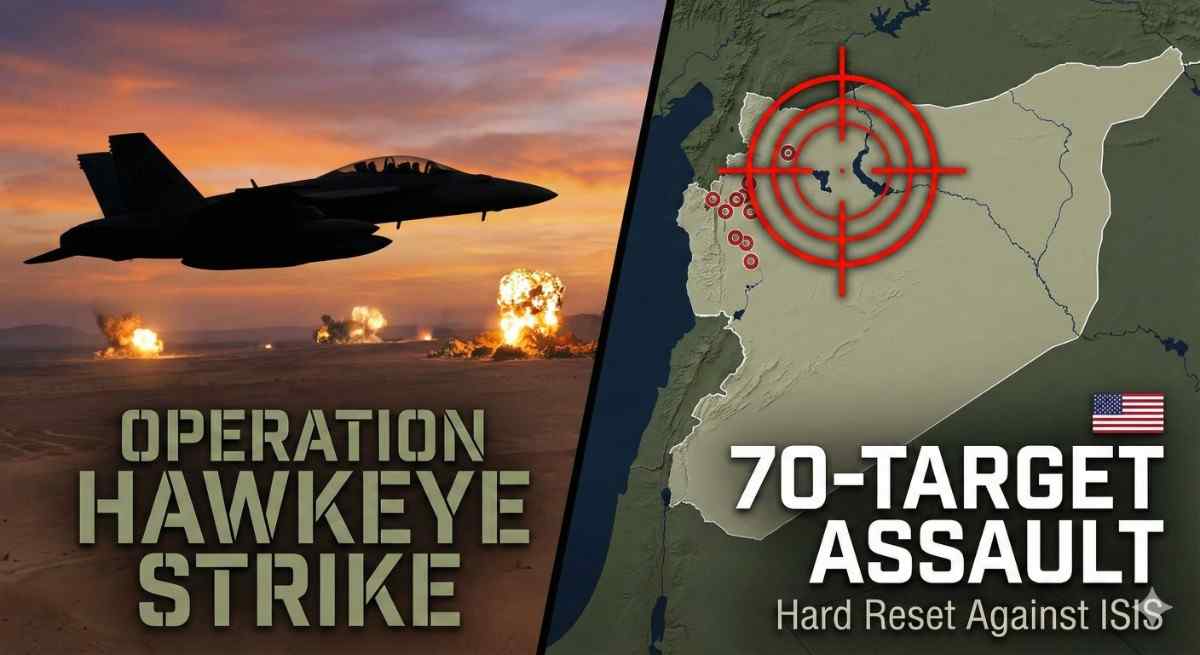
Operation Hawkeye Strike is the United States’ clearest reminder—loud and unapologetic—that the war against Islamic State is far from over. Launched in mid-December 2025, this operation wasn’t a symbolic air raid or a limited response. It was a full-spectrum, precision-heavy military campaign aimed at dismantling ISIS infrastructure across central and eastern Syria in one decisive blow.
At its core, Operation Hawkeye Strike was retaliation. After an ISIS attack near Palmyra killed two American soldiers and a civilian interpreter, Washington decided that warnings were done. The response came swiftly: over 70 ISIS targets hit in a single coordinated operation, using fighter jets, attack helicopters, artillery, and more than 100 precision-guided munitions. This wasn’t escalation for optics—it was escalation by design.
The operation was executed under the command of US Central Command (CENTCOM), the backbone of American military operations in West Asia. CENTCOM’s objective was blunt: degrade ISIS’s ability to plan attacks, operate drone cells, move weapons, and inspire lone-wolf strikes beyond Syria. In modern counterterrorism language, this is called capability denial, not territory capture—and that tells you a lot about how this war has evolved.
One key detail that makes Operation Hawkeye Strike stand out is coalition coordination. The Jordanian Armed Forces provided air support, reinforcing the idea that counter-ISIS operations are no longer a solo American burden but a shared regional priority. This cooperation also signals something bigger: neighboring states see ISIS not as a “contained Syrian problem” but as a cross-border threat that never really died after 2019.
Politically, the messaging was just as aggressive as the military action. Donald Trump framed the strikes as “serious retaliation,” making it clear that attacks on U.S. personnel would invite overwhelming force, not calibrated restraint. Meanwhile, Defense Secretary Pete Hegseth’s statement—calling the operation “retribution, not war”—was intentional. The U.S. doesn’t want another Middle East occupation, but it absolutely wants deterrence restored.
Strategically, Operation Hawkeye Strike reflects a post-territorial counterterrorism doctrine. ISIS no longer controls cities, but it controls networks, cells, and ideology. The U.S. response therefore focuses on eliminating leaders, weapons caches, and operational hubs rather than chasing flags on maps. It’s quieter, faster, and deadlier.
Bottom line? Operation Hawkeye Strike is not about reopening the Syrian battlefield—it’s about keeping ISIS permanently off balance. It signals that even a “defeated” terror group doesn’t get breathing room, and that the U.S. will still strike hard, strike fast, and strike first when its red lines are crossed. Old-school deterrence, modern execution. No sugarcoating.
Why the US Struck Now: The Palmyra Attack and America’s Red Line
Timing is everything in geopolitics—and the U.S. strike under Operation Hawkeye wasn’t random, emotional, or impulsive. It was triggered by a very specific event: the Palmyra attack in central Syria, where two American soldiers and a civilian interpreter were killed. For Washington, this wasn’t just another hostile incident in a messy conflict zone. This crossed a clear red line.
Palmyra matters. Strategically located between eastern and central Syria, it sits near known transit routes used by ISIS sleeper cells. When an ISIS gunman attacked U.S. personnel there, it exposed something deeply uncomfortable for Washington: ISIS may be territorially defeated, but it is still operationally alive. And more importantly, it showed that American forces—deployed primarily in advisory and counterterror roles—remain direct targets.
From the U.S. perspective, allowing such an attack to pass with a muted response would have been dangerous. Not just militarily, but psychologically. Deterrence in counterterrorism isn’t about occupation anymore; it’s about credible punishment. If attacks on U.S. troops go unanswered, it sends a green signal—not just to ISIS, but to every non-state actor watching closely.
That’s why the response was immediate and overwhelming.
Unlike earlier years, the U.S. didn’t wait for months of intelligence layering or diplomatic choreography. Within days, US Central Command launched coordinated strikes across more than 70 ISIS-linked targets. This speed was intentional. It reinforced the idea that any direct harm to American personnel will invite disproportionate consequences.
Another reason the U.S. struck now lies in the broader regional context. ISIS has been quietly attempting a comeback by exploiting governance gaps in Syria’s deserts and border regions. According to UN estimates, thousands of ISIS fighters remain active across Syria and Iraq. The Palmyra attack wasn’t an isolated incident—it was a stress test. And from Washington’s viewpoint, failing that test was not an option.
Political signaling also played a role. Donald Trump made it clear that attacks on Americans would not be met with “strategic patience.” His messaging was blunt, almost old-school: you hit us, we hit back harder. In an era where U.S. credibility is constantly scrutinized—from Ukraine to the Indo-Pacific—letting the Palmyra attack slide would have weakened America’s deterrence narrative globally.
There’s also a domestic angle. The deaths of U.S. soldiers abroad carry political weight at home. Swift retaliation reassures military families and the broader public that deployments, however limited, are not treated casually. It reinforces the idea that American lives are non-negotiable—whether the threat comes from a state actor or a shadowy terror network.
In essence, the Palmyra attack forced the U.S. to draw a thick, unmistakable line. Operation Hawkeye Strike wasn’t about revenge—it was about restoring fear in the minds of ISIS operatives. The message was simple and brutally clear: you may hide in deserts, you may regroup quietly—but if you touch American forces, there will be nowhere left to hide.
That’s America’s red line. And at Palmyra, it was crossed.
Firepower and Coordination: How CENTCOM Executed 70+ Precision Strikes
Operation Hawkeye Strike wasn’t about brute force—it was about controlled devastation, executed with textbook precision. The architect behind this operation was US Central Command (CENTCOM), and the way it coordinated more than 70 near-simultaneous strikes shows how far modern U.S. warfare has evolved from boots-on-ground battles to network-driven combat dominance.
First, the firepower mix matters. CENTCOM deployed a layered strike package that included fighter jets, attack helicopters, and long-range artillery. Each platform had a distinct role. Fighter aircraft delivered deep-penetration precision strikes against hardened ISIS infrastructure—command centers, weapons depots, and logistics hubs. Attack helicopters focused on mobile targets, including moving vehicles and desert hideouts that ISIS fighters use to evade detection. Artillery was used selectively to hit fixed positions in remote terrain where air assets alone would have been inefficient.
What made this operation lethal wasn’t just weapons—it was intelligence fusion. CENTCOM relied on real-time ISR (Intelligence, Surveillance, and Reconnaissance) assets, including drones, satellites, and human intelligence from partner forces on the ground. This allowed commanders to strike targets almost simultaneously, denying ISIS the chance to relocate leaders or disperse assets once the first bombs fell. In counterterrorism terms, this is called a compression strike—hit everything before the enemy can react.
A standout feature of Operation Hawkeye Strike was coalition coordination. The Jordanian Armed Forces played a direct support role, providing fighter aircraft and regional operational assistance. This wasn’t symbolic participation. Jordan’s involvement improved airspace coordination, reduced response time, and reinforced intelligence-sharing pipelines that are critical in desert warfare. It also sent a regional signal: ISIS is no longer being tolerated as a “manageable nuisance” by neighboring states.
CENTCOM confirmed that over 100 precision-guided munitions were used—each selected to minimize collateral damage while maximizing operational impact. This is crucial in Syria, where civilian casualties can quickly become strategic liabilities. Precision wasn’t just about ethics; it was about legitimacy. By striking only verified ISIS targets, the U.S. preserved international backing while still delivering a devastating blow.
Another key element was command decentralization. Modern CENTCOM operations allow field commanders greater autonomy once targets are validated. This reduces bureaucratic lag and enables faster decision-making. In practical terms, that means pilots, drone operators, and artillery units were able to act within pre-approved engagement frameworks, rather than waiting for case-by-case political clearance.
The strikes also targeted ISIS’s operational ecosystem, not just fighters. Drone workshops, weapons caches, safe houses, and transit corridors were all hit. This matters because ISIS survives not through territory but through networks. Destroy the network, and you suffocate the group without needing prolonged occupation.
Perhaps the most important takeaway is this: Operation Hawkeye Strike demonstrated deterrence through competence. ISIS didn’t just face firepower—it faced a seamlessly coordinated, multi-domain assault that left no room for improvisation or escape.
In short, CENTCOM didn’t just hit ISIS hard. It hit ISIS smart. And in modern counterterror warfare, smart is far deadlier than loud.
ISIS Today: Weakened but Dangerous—The Reality on Ground in Syria and Iraq
Let’s get one thing straight—Islamic State is not what it was in 2014. The black flags don’t fly over cities anymore, there’s no “caliphate,” and the propaganda machine is weaker. But calling ISIS finished would be a rookie mistake. On the ground in Syria and Iraq, the group has adapted—and that’s what makes it dangerous.
ISIS today survives in fragments, not frontlines. Instead of controlling territory, it operates through sleeper cells scattered across deserts, border zones, and poorly governed rural pockets—especially in eastern Syria and northern Iraq. These regions are ideal: vast terrain, limited state presence, and competing militias. In short, perfect cover. This is why attacks like the one in Palmyra still happen despite years of counterterror operations.
According to assessments cited by the United Nations, ISIS still has 5,000–7,000 fighters across Syria and Iraq. That number alone should kill the “ISIS is over” narrative. These fighters aren’t marching in columns—they’re blending into civilian life, running extortion networks, smuggling weapons, and launching hit-and-run attacks on security forces. It’s insurgency 101, and ISIS has learned it well.
Another underestimated threat is ISIS’s leadership structure. While top leaders have been eliminated repeatedly, the group has shifted to a decentralized command model. Local commanders now operate with greater autonomy, reducing the impact of leadership decapitation strikes. Kill one leader, another steps in—often faster and quieter. This flexibility is exactly why ISIS has outlasted predictions of its collapse.
Then there’s the prison problem. Thousands of ISIS fighters and sympathizers remain detained in overcrowded facilities in Syria, guarded by overstretched local forces. These prisons are ticking time bombs. Any large-scale breakout—or collapse of local security—could instantly replenish ISIS ranks. The group knows this, and prisons remain long-term strategic targets.
Ideology is another battlefield ISIS hasn’t lost. Online propaganda may be muted compared to its peak, but it hasn’t disappeared. Encrypted platforms and regional networks still circulate recruitment material, especially targeting disillusioned youth in conflict zones. ISIS doesn’t need mass recruitment anymore—it just needs enough believers to stay alive.
Crucially, ISIS thrives on instability. Syria’s unresolved civil war, Iraq’s fragile political balance, and tensions between regional and international actors all create gaps. Every gap is an opportunity. When state focus shifts elsewhere—Ukraine, Gaza, Indo-Pacific—ISIS tests the vacuum. The Palmyra attack was one such test.
This is exactly why operations like Hawkeye Strike matter. Not because ISIS is strong—but because it is persistent. It survives by waiting, adapting, and striking when attention drops. That makes complacency its greatest ally.
So yes, ISIS is weaker. Militarily degraded. Financially constrained. But dangerous? Absolutely. A cornered insurgent group with nothing to lose is often more unpredictable than a powerful one.
The ground reality in Syria and Iraq is simple and uncomfortable: ISIS no longer rules—but it refuses to die. And that’s why vigilance, not victory declarations, remains the only realistic strategy.
Bigger Picture: What Operation Hawkeye Strike Means for US Policy in the Middle East
Operation Hawkeye Strike isn’t just a counterterror mission—it’s a policy signal wrapped in precision strikes. In one coordinated move, the United States clarified what its Middle East posture looks like in 2025: fewer speeches, faster retaliation, tighter coalitions, and zero tolerance for attacks on American personnel. This is deterrence, updated for a post–forever war era.
First, the operation reinforces a “no-occupation, high-impact” doctrine. The U.S. has learned—sometimes the hard way—that large troop deployments create diminishing returns. Instead, Washington is betting on intelligence dominance, rapid strike capability, and coalition support. By empowering US Central Command to execute swift, multi-domain operations, the U.S. keeps pressure on terror networks without reopening nation-building chapters nobody wants to reread.
Second, Hawkeye Strike redraws the red lines—and makes them credible. The message is blunt: attacks on U.S. forces will be met with disproportionate consequences, regardless of where they occur. That’s not escalation; it’s clarity. In a region crowded with state and non-state actors testing boundaries, clarity matters. It tells militias, proxies, and terror cells that ambiguity is gone—and miscalculation will be costly.
Third, the operation elevates coalition-first security. The involvement of the Jordanian Armed Forces underscores a shift from U.S.-centric action to shared regional responsibility. This approach spreads risk, improves intelligence sharing, and—critically—adds legitimacy. Counterterrorism works better when neighbors buy in, especially against groups like Islamic State that thrive on cross-border seams.
Fourth, Hawkeye Strike fits neatly into America’s broader prioritization strategy. With attention split across Europe and the Indo-Pacific, the U.S. is signaling it can still act decisively in the Middle East without distraction or delay. That’s important. It reassures partners that Washington hasn’t “left the region,” while warning adversaries that strategic focus elsewhere doesn’t equal vulnerability here.
There’s also a political dimension at home. Swift retaliation reinforces public confidence that overseas deployments—however limited—are protected. For leadership, it demonstrates resolve without committing to endless wars. That balance is the holy grail of modern U.S. foreign policy: strong enough to deter, restrained enough to sustain.
Finally, the strike acknowledges an uncomfortable truth: counterterrorism is now about management, not victory parades. ISIS may be degraded, but it persists. The U.S. response isn’t to chase total eradication through occupation; it’s to deny space, disrupt networks, and impose constant costs. Think pressure cooker, not knockout punch.
Bottom line? Operation Hawkeye Strike tells us the U.S. Middle East policy is neither withdrawal nor domination—it’s disciplined assertiveness. Strike when necessary. Partner when possible. Leave no doubt about consequences. Old-school deterrence, modern execution—and a reminder that in this region, credibility is currency.
About The Author











Leave a Reply